


 0345 646 5201

You’ve built something significant. Can your people strategy keep up?
At a certain point in every business’s growth, the approach to people that got you here stops being enough for where you are going. The leadership structure that worked at 50 people shows strain at 150. The informal ways of doing things that once felt like a strength begin to feel like a risk. The board starts asking people questions you cannot fully answer yet.
This is not a failure. It is what scaling looks like, and it’s really normal. But it’s lso exactly the moment when getting people strategy right makes the difference between a business that powers through to the next level and one that gets stuck.
People Puzzles works with businesses at precisely this point, providing board-level people leadership, embedded in your team, at the pace your business is moving.
Your business has changed. The way you make people decisions needs to change with it.
Scaling businesses reach this moment via different routes. Sometimes it is a round of investment or a management buyout, sometimes it’s sustained organic growth outpacing the infrastructure, or a senior leader departure that has exposed structural risk. Sometimes it is a board or investor asking questions that reveal just how much is still held together by individual relationships rather than defined, well-understood processes.
However you’ve got to this point, the symptoms tend to look similar:
- Leadership capability that was right for the business two years ago is inconsistent at the level the business is now operating at
- People decisions are still being made on instinct or relationships rather than on data, strategy or governance
- Key-person dependency is creating real risk: one or two individuals holding more than they should, with no succession plan
- Management standards vary widely across teams and departments
- The board or your investors are asking people questions about culture, capability, retention or structure that the business can’t yet answer confidently
- You’re growing into new markets, geographies or product areas and the people infrastructure has not kept pace
The common thread: you have a business that has grown beyond the point where these things sort themselves out. They now need to be actively led.


Board-level people strategy. Without the full-time C-suite hire.
A People Puzzles People Director works part-time within your business, typically two or three days a week, operating at the same level as any other board member. They own the people strategy, sit in the leadership team conversations, and are accountable for building the people infrastructure your business needs for its next stage.
This is not just operational HR support. It is strategic people leadership: the thinking, the decisions, and – critically – the doing. And because they are part of our network of 85+ People Directors, the specialism your particular challenge requires is always available, even if it sits in a colleague rather than your lead contact.
What does Board-level people leadership looks like in practice?
- A people strategy that is explicitly tied to your commercial growth plan and answers the questions your Board is asking
- Leadership development and management standards that are consistent across the business, not dependent on who you happen to have in each role
- Workforce planning and organisational design built for where the business is going, not where it has been
- Succession planning and key-person risk managed deliberately, not left to chance
- The people data and governance your board or investors need, so “people” is never the weakest element in a board pack
- Recruitment and retention strategy that gives you a genuine edge in a competitive talent market
- Support through the specific moments that require it most: a leadership departure, a restructure, a new market entry, a change of ownership
Investment is one trigger. It is not the only one.
Some of the businesses we work with at this stage have private equity or venture capital backing. Many do not. They are founder-built businesses that have grown organically to a scale where informal people management has run its course. Management buyouts where the new leadership team is building proper commercial infrastructure for the first time, family businesses that have professionalised and now have a board and external shareholders asking harder questions – you get the idea.
What they share is not a funding structure, but a moment in time: the business has reached a level of scale and complexity where people leadership needs to be deliberate, strategic and properly resourced. That is the moment we work with.
Doubling turnover. In three years. With a people strategy at the centre of it.
In 2020, multi-disciplinary property consultancy Barker Associates had 50 employees and a turnover of around five million pounds. Three years later, working with People Director Lois Moore, they had more than doubled their turnover to twelve million and grown their headcount to 140.
The challenge was not that anything was broken. It was that the business was growing at a pace that its people infrastructure was not designed to sustain. Recruitment was reactive. Career pathways were unclear. Communication was inconsistent. The foundations that would have held the business together at its previous size were starting to show the strain of something significantly bigger.
Lois worked with the leadership team to build the people strategy from the ground up: career pathways and competency frameworks, a management development programme, a total reward review, a new onboarding process scalable enough to handle rapid hiring, and an HR infrastructure that could manage the volume and complexity the growing business demanded.
Through the work that Lois has done and the benefits of focusing on a strategic people plan, we are now in a fantastic position — securing the future of the organisation in the long term. It also means we are now attracting the best people to drive our business growth.
Stuart White, Managing Partner — Barker Associates
Knowing when to step back -- and building the structure that makes it possible.
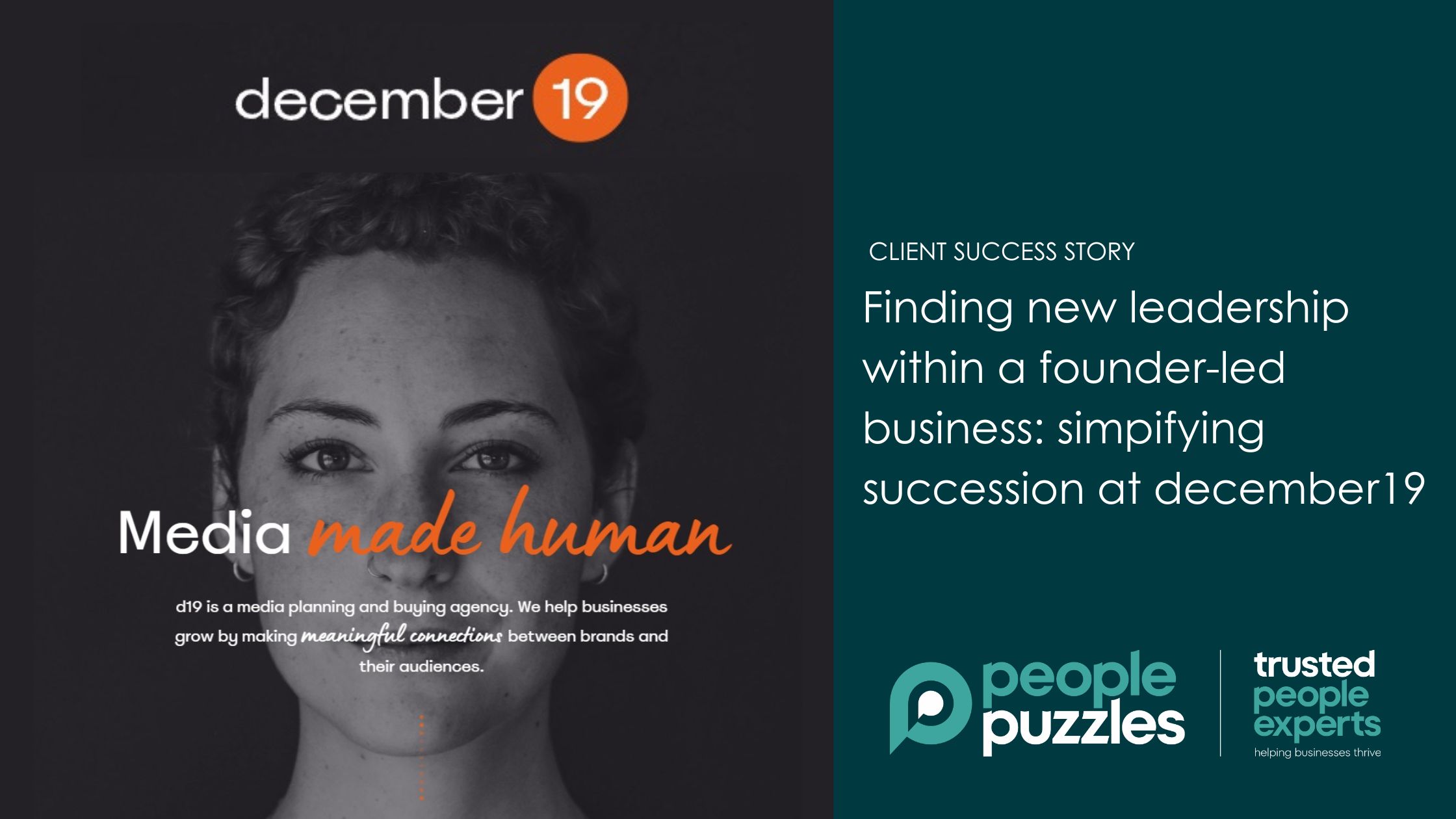
December19 is a values-led media agency founded by Dave Barnett and Dan Pimm, recognised five consecutive years in Campaign’s Best Places to Work list. By any measure, the culture was exceptional. The challenge was structural: as the business grew and matured, the founders recognised that the next stage of growth needed a different kind of leadership — and that stepping back from day-to-day operations was the right move for the business, however personally complex that decision was.
Already familiar with the fractional model through their part-time CFO, the founders brought in People Director Helen Witt to design and lead the internal succession process. Helen developed the organisational structure, ran a carefully managed internal recruitment process complete with psychometric assessment, navigated the sensitive dynamics of internal candidacy, and then designed the transition period to bring the successful candidate, David Lucy, forward gradually.
The founders are now focused on B Corp accreditation and longer-term strategic growth. The business has the leadership structure it needs to power forward on its own terms.
Helen’s approach was spot-on. She knew we didn’t want a big corporate approach and her direct, highly strategic yet hands-on style suited us really well. She helped us work out what we needed and wanted, and gave us the guidance and support to make difficult decisions and see a clear path forward.
Dave Barnett, Co-Founder — December19
85+ People Directors. The right one for you is ready and waiting to help.
People Puzzles is the UK’s largest team of fractional People Directors. We are not a consultancy that parachutes in with a framework, or leaves you with a huge to do list to deliver yourself. We embed a People Director in your leadership team, someone who knows your business, who sits in the conversations that matter, and who is accountable for the people side of your growth in the same way a full-time hire would be.
The difference is that behind every People Puzzles engagement is the collective experience of 85+ practitioners. Whatever your specific challenge – reward, ED&I, TUPE, succession, organisational design, management development – that specialism exists somewhere in our network and your People Director can draw on it.
Why scaling businesses choose us:
- We are faster to deploy than a permanent hire, in place within days, not months
- We operate at Board level and carry the credibility that requires
- We flex to your pace; more days in intensive periods, fewer in steady-state ones
- Our People Directors have held senior roles in significant organisations – they have been in your board meetings before
- We don’t just build the strategy. We deliver it alongside you.
- We are UK-wide, so wherever your business is, we have the right person near you
FAQs
How is this different from just hiring a part-time HR manager?
An HR manager runs processes: contracts, admin, compliance, policies. A People Director runs strategy: how the business is structured, how leadership is developed, how people decisions connect to commercial outcomes, how the board is answered on people matters. The seniority and the scope are completely different. At the stage your business is at, the gap that needs filling is strategic, not operational.
We already have an HR manager. Does a People Director work with them?
Yes, and this is a very common arrangement. The HR manager runs day-to-day operations. The People Director provides the strategic leadership layer above that: setting direction, representing people at board level, making the decisions that require that seniority. The two roles are complementary, and a good People Director will develop your HR manager’s capability as part of the engagement.
We're PE-backed. Is there a more specific page for us?
Yes — see our investment-backed businesses page, which covers the specific people challenges and opportunities that come with PE and VC backing: investor expectations, rapid scaling, post-investment transformation, and the particular pressure on people strategy that comes with external capital. This page is for the broader scaling audience.
How do we know when we have outgrown the owner-managed approach to people?
A few reliable signals: your board or investors are asking people questions you cannot fully answer; a leadership departure has exposed how much was held together by one person; management quality is inconsistent across the business; you have had retention problems you did not see coming; your people decisions are still being made on gut feel rather than data or strategy. If more than one of those is true, you have outgrown it.
What does the engagement typically look like at this stage?
Most scaling businesses work with a People Director two to three days a week. The engagement typically starts with a diagnostic — understanding the people infrastructure as it stands, the gaps relative to where the business is heading, and the priorities for the first 90 days. From there it is ongoing: strategy, delivery, board representation, and developing capability within the business alongside the immediate work.
Can you help us think about whether we need a full-time People Director eventually?
Yes — and we will tell you honestly when that point is approaching. Most businesses at your stage do not need a full-time People Director yet, but there is a point where the business complexity and headcount make it the right move. A good fractional engagement builds toward that transition rather than avoiding it — including helping you define the role and find the right person when the time comes.
The businesses that scale well treat people strategy as seriously as financial strategy.
The gap between a business that navigates this stage well and one that plateaus is rarely product, market or funding. It is people: the quality of leadership, the strength of culture, the clarity of structure. Tell us where your business is, and we’ll match you with a People Director who has navigated exactly this point before.
See what our clients say!

Clyde has been instrumental in taking BEAR Scotland from 'good to great'
Iain Murray, Managing Director, BEAR Scotland
Working closely with Clyde Marwick we developed a five-pillar framework addressing our goal for a high performing HR function including employer branding, recruitment innovation, and reward enhancement. We have navigated complex employee relations challenges while building strategic capability across our HR team. We now have the people infrastructure to match our operational excellence.
Liz's support was instrumental in us delivering a successful consultation
Director of Finance, National Hair & Beauty Federation
Following the completion of our restructure, I wanted to get in touch to say thank you. Liz's support was instrumental in us delivering a successful consultation. We are extremely grateful for her measured and sound advice, helping us to navigate such a sensitive situation, and we look forward to working with her again in future .
Lynn guided me out of my comfort zone to help me achieve my goals
Samantha Freeman, Management Accountant, Wirtgen Group
I could not recommend Lynn more, she guided me out of my comfort zone to help me achieve my goals and to think about things from an alternative perspective. I have also had a few people comment on the positive changes they can see in me which is a result of our sessions.
Sarah is a trusted advisor and sounding board to both me and my team.
Claire Watkin, Managing Director, Trendsetter
Working with People Puzzles has enabled me to step out of the day to day running of the business and concentrate on our future strategic direction. Sarah has helped us focus on how we develop our future leaders, cross team collaboration, and enhance overall business performance, as well as supporting the achievement of B Corp status.
The achievements of the People Strategy made a measurable difference.
Craig Bennett, Chief Executive Officer, Sigma
I can't thank Paula enough for all her support over the last 3 years. Her time with us turned out to be much longer than any of us expected but I guess this reflects the extraordinary events and circumstances we’ve encountered since 2019. The achievements over this period made a measurable difference to engagement and has helped Sigma transition our people policies from that of an SME into market leading large corporate. Thank you.
Lynn was always positive and listened when it mattered
Coaching Client – Wirtgen Limited
I cannot give Lynn enough thanks for the help that she gave me to better understand myself and help me find the answers to some tough questions. Lynn was always positive and listened when it mattered, Thanks again Lynn.
I have been able to build a proactive relationship with Pauline
Amy Fisher, MD, Doby Verrolec
I have been able to build a proactive relationship with Pauline. I came into this role last year with an agenda for growth and we have been working together across employee engagement, contacts and policies.
Pauline developed our people strategy with a robust methodology
Jeremy Royle, MD, YourNRG
Pauline’s hands on approach helped us to build on the work we have already taken and develop our people strategy with a robust methodology to meet the current needs and future growth of the business.
Working closely with one local and very knowledgeable person
Amy Fisher, MD, Doby Verrolec
The real benefit of People Puzzles is that your business and industry sector needs are matched with one of the People Puzzles Directors. This means you work closely with one local and very knowledgeable person who can quickly understand the people needs of the business.
Working with Sarah has been a rewarding, productive and an educational experience
Chief Operating Officer, Salford Primary Care Together
We wanted to understand more about what was driving our organisational culture, key risks and issues, what our priorities should be, and to understand what we could achieve with our limited resources. Sarah brought commitment, pragmatism, and positivity to our challenges which helped us achieve many of our goals including organisational restructures, re-design of several key HR processes and upskilling of our teams.
Pauline has very quickly gotten to grips with Your NRG.
Managing Director, Your NRG
Pauline has very quickly gotten to grips with Your NRG, and has brought to our attention some processes that need our focus as a result of our recent rapid growth. We are pushing on with the more pressing operational day-to-day strategies and initiatives whilst also educating the SMT on their overall understanding of ‘cradle to grave’ employment. Pauline continues to work diligently and tirelessly for Your NRG and I am delighted to have her ongoing support alongside us as we continue on our journey to realise our levels of ambition.
Changed the way we approach our senior meetings and develop our strategy.
Chair, Regular Cleaning
Shaun worked closely with me and the senior team and taught us a lot. Shaun dedicated time for each team member and encouraged, educated and guided them to be the best they can be. We achieved so much in the time we worked with Shaun and he has helped to change our focus from working in the business to working on the business giving us time to dedicate to the progression of the teams that make up the rest of our family.
Jill has worked on many projects as our part time HR Director.
Founder, Aura
One was around sick days which she has now reduced by 75%. This has significantly minimised the disruption it was causing.
Stewart's work has been a major factor in helping us achieve our ambitious targets.
Gerry Simmonds, Safpro
Stewart helped to align our senior team around business goals and implemented clear people plan has been a major factor in helping us achieve our ambitious targets. We have grown 20% over the past two years and with the team we now have in place this growth is set to continue.
Lynn's work as our trusted HR consultant and my mentor has been absolutely invaluable.
Oktawia Ellis, HR Manager, We Seal
I have the distinct pleasure of working with Lynn at People Puzzles. Her work over the last few years as our trusted HR consultant and my mentor has been absolutely invaluable. Lynn is an expert in her field, she is very knowledgeable, encourageing, supportive, and an effective leader. She is also really funny and a pleasure to be around! I learned a lot from Lynn and I would strongly recommend her.
The impact Lynn has had on our challenges are beyond my expectations
James Laxton, Managing Director, Laxtons
She has engaged with all our staff and her approach is a breath of fresh air for the business. The support she has given me has made some difficult issues appear straight forward and she has given a new lease of life in the business. We would not have been able to get to where we are now without her wealth of experience and hands on people approach and I am excited to see what the future brings working with Lynn.
Every team leader can now make decisions in line with the vision
Roy Bowie, Managing Director, GreenBlue Urban
I used to have the view that HR was managing difficult cases and moving people on with occasional recruitment support. But what People Puzzles does is so much more than that. It’s about the development of the business and its people as a whole which has been the biggest eye opener for me.
Working with Gill has helped us develop a People Plan which goes beyond compliance
Bernard Sellars, Managing Director, Lindum Packaging
Working with Gill from People Puzzles has helped us develop a People Plan which goes beyond compliance – it has helped us as a team to achieve greater alignment and engagement with the business strategy and goals.
I found the personal development coaching I received from Lynn to be very beneficial.
Alex Calvert, Marketing and PR Account Manager, Intandem Communications Ltd
I found the personal development coaching I received from Lynn to be very beneficial. Lynn helped me to work on some very clear objectives with a good balance of supportiveness and knowing when to challenge and push me out of my comfort zone!
We are now in a strong position from a people perspective, to leverage the future
Craig Bennett, CEO, Sigma Group
Paula developed a clear People plan and road map, which has significantly moved us on. She has developed the existing HR team, and ensured that we progressed quickly on all the initiatives that we identified. I’m confident that based on the last 6 months, with Paula’s input and contribution, we are now in a strong position from a people perspective, to leverage the next 6 months and beyond.
A very professional team
Chris Morling, Founder & CEO, Money.co.uk
It’s been brilliant to have such knowledgeable consultants help us to empower our people. Stuart and Sophie were incredibly flexible, adapting their services to our business and existing culture. I’d highly recommend People Puzzles.
Shifted my view of HR!
Gavin Pooley, Managing Director, Liquidline
I used to think that HR was all about employment law compliance and managing the administration basics. I didn’t get the hugely positive impact strategic HR could make to the business – I do now!’
Transformed my understanding
Managing Director, B2B Supplies and Support Services
Having Alison on the team is like having another MD/MBA in the business. She has totally transformed my understanding of HR.
Fantastic support!
Kerry Berry, Director, S&K Berry Associates LLP
Lynn has been a fantastic support to us and an ongoing fountain of knowledge. If you have a business and/or staff you need to take care of, you need a Lynn on your team!
Such a detailed process
Sue Ford, Director, Bridge Case Management
Lynn ran a detailed process and I wasn’t allowed to get away with anything – All relevant issues were included and dealt with objectively.
We’ve accomplished a lot!
Joseph Carr, Managing Director, Carrs Pasties
This is an inspiring story and it’s all true. I can’t believe it’s about us! We’ve accomplished a lot over the last 18 months.
Helping us shape the business
Stuart Hill, CEO, WNDirect
Carole has helped me and the business massively and added real value while helping us shape the business.
Vee has delivered a huge amount for the company
Bertie Kerr, Managing Director, Albany Associates Ltd
Vee started with a baseline study of where we were. She then presented a work plan to deliver over the coming months and while some priorities have changed it is impressive to look back and see how much has been achieved. She has become a trusted member of the senior team, providing advice and guidance on difficult topics and is regularly consulted by staff for her input.
Alison joined Valleys to Coast on an interim basis and 18 months later is still with us!
Joanne Oak, Chief Executive Officer, Valleys to Coast Housing
Alison has been instrumental working with me to recruit to a permanent role. Alison’s approach has been one of partnership, contributing as part of the strategic leadership team, which has been critically important given the turbulence the organisation has been through. Alison is always available, responsive and I would highly recommend her for expert HR support
Over the last 3 years, People Puzzles has helped build a very strong people culture
Phil Dupont, Director, RVT Group
We now have a clear Vision for the Companies 5 Pillars, In-house manager, leadership ‘Power 90’ Training and a rhythm of key meetings throughout each year. This has had a direct contribution to the significant growth of the company in the last 3 years… With this support from People Puzzles continuing, the company continues to grow both financially and culturally for the benefit of all.